

What Is Spinal Decompression? A Plain-English Guide
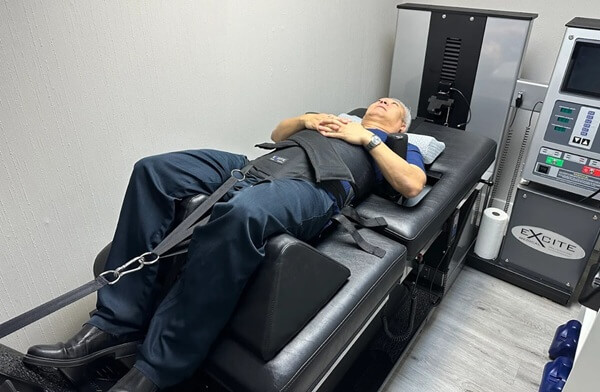
If you have been Googling your back pain at 2 a.m., you have probably bumped into the phrase spinal decompression and wondered whether it is a real medical treatment or just another gadget with a fancy name. Fair question. Here is the plain-English version, no sales pitch attached.
In this article
So What Is Spinal Decompression, Exactly?
Spinal decompression is a non-surgical treatment for disc problems. You lie on a motorized table, a computer-controlled machine applies a gentle, precisely calculated pull to your spine, and that pull lowers the pressure inside a compressed disc. It exists because so much back and neck pain comes down to one mechanical fact: a disc has been squeezed until it bulges or herniates into a nerve.
Lower the pressure inside that disc and something useful happens. The disc behaves like a vacuum, drawing in water, oxygen, and nutrients, and it can gradually retract back toward its normal position, away from the nerve it was pinching. That is the whole idea. No incisions, no injections, no medication.
Is This the Same as Traction or an Inversion Table?
No, and this is where most of the confusion lives. Traction and inversion tables stretch everything at once, muscles included, with the same force for every person. A true decompression system like the DRX9000 calculates the pull from your individual body weight, never more than half of it, and cycles through gentle pull-and-release phases designed to reach the disc rather than just stretch the muscles around it.
Dead hangs from a pull-up bar and decompression belts live in the same neighborhood as inversion tables. They may feel good for a few minutes, but they are not the computer-controlled, disc-targeted treatment that FDA-cleared decompression equipment delivers.
Non-Surgical vs. Surgical Decompression
One more distinction worth knowing. Spinal decompression surgery, such as a laminectomy, is an operation where a surgeon physically removes bone or tissue to make room for a nerve. It has its place, usually in severe cases, and it comes with anesthesia, hospital time, and a real recovery period.
Non-surgical spinal decompression, the kind this article is about, is the conservative cousin. You stay fully clothed, you lie comfortably on a table for about half an hour, and you drive yourself home afterward. For many people with disc problems, it makes sense to exhaust this option before anyone talks about operating.
Who Actually Performs It?
Chiropractors are the providers who most commonly offer non-surgical spinal decompression, and the equipment matters as much as the provider. At Dallas Spine Center in Carrollton, Dr. Hoa Nguyen runs the DRX9000 on the full research protocol: 18 pull-and-release cycles per session, 28 to 30 minutes on the table, across 20 to 28 visits. Not every clinic follows the protocol that closely, so it is a good question to ask wherever you go.
“Spinal decompression is a non-surgical solution to help relieve your back pain. It gently pulls the vertebrae in the opposite direction so the compressed disc has less pressure inside, and it helps retract the disc so it will not pinch the nerve that causes your pain.”
Dr. Hoa Nguyen, D.C.The Short Version
- Spinal decompression treats compressed, bulging, and herniated discs, along with the sciatica and pinched nerve symptoms they often cause
- It is computer-controlled and calculated to your body weight, unlike traction, inversion, or DIY hanging
- It is non-surgical: no cuts, no drugs, no downtime
- Wondering what a session is actually like? We wrote about what spinal decompression feels like, and the answer surprises people
If your back pain traces to a disc, the full breakdown of how we run this treatment lives on our spinal decompression page, and finding out whether you are a candidate takes one $47 visit with an exam and x-rays included.
Curious if Decompression Fits Your Back?
One visit answers it: a consultation, an exam, and in-house digital x-rays for $47 at our Carrollton office on North Josey Lane. From there, the findings decide, not a sales pitch.