

What Does Spinal Decompression Feel Like? (Most People Nap)
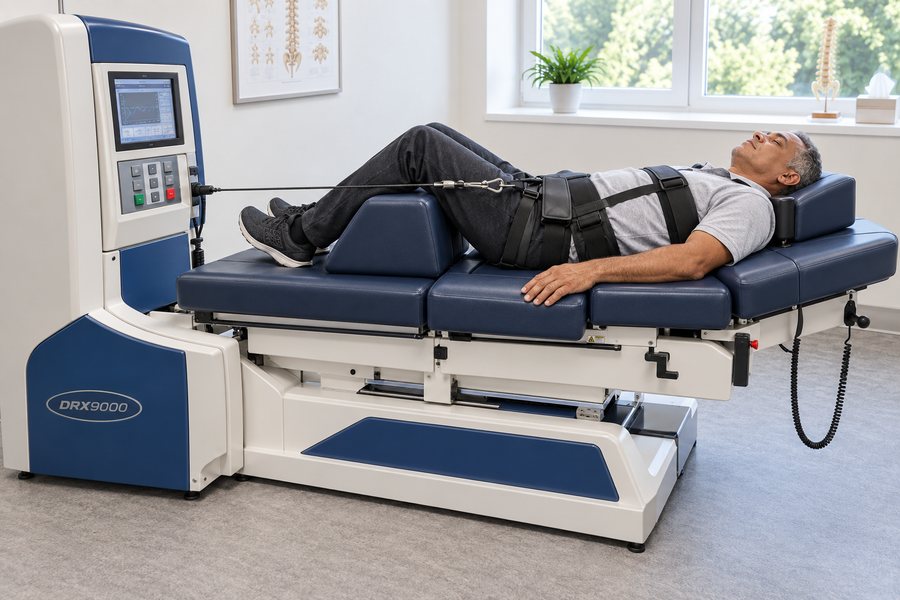
Here is a spoiler for the nervous: the most common thing patients do during spinal decompression at our Carrollton office is fall asleep. More than a few snore. If you are picturing a medieval stretching rack, this article should put your mind at ease, and it will also tell you honestly about the one mild reaction some people feel afterward.
In this article
What a Session Actually Feels Like
You lie face up on the DRX9000 table, fully clothed. A brace is fitted around you, your neck gets a pillow, your knees get a support, and the table declines slowly until you are comfortable. Then the machine begins its work: a gentle pull, a release, another pull, in slow cycles for 28 to 30 minutes.
The sensation is a mild, rhythmic stretch through your lower back or neck. It is not sharp, not sudden, and never more than your body was calculated to handle, because the pull is capped at half your body weight and your first visit starts at just 60% of that. Most patients describe it the way Dr. Nguyen does: like a spa day, or a forced half-hour break from a long day. Why does spinal decompression feel good? Because pressure coming off a nerve is one of the most relieving sensations a spine can experience.
Does It Hurt? And Why Might I Be Sore After?
The treatment itself should not hurt. Where honesty is required is afterward: some patients feel a dull, muscle-level ache for a few days, and it helps to know why. When the same muscles get pulled session after session, they can push back. Muscles do not love being stretched repeatedly, and a muscle that fights the pull will complain about it later, the same way it would after a new workout.
“Try to relax and let the machine pull at the disc, not against the muscle. When muscles are pulled, they react and cause a dull pain. It typically lasts a few days in some cases, and it is completely normal. It is not something to be alarmed about.”
Dr. Hoa Nguyen, D.C.That is the full list of common side effects. No incision to heal, no medication to metabolize, no downtime to schedule around. You get off the table and go about your day.
Is Spinal Decompression Safe?
For the right patient, yes, and the phrase the right patient is doing real work in that sentence. Decompression is safe precisely because good clinics screen for the cases where it does not belong. At Dallas Spine Center that screening happens before treatment is ever offered: a consultation, an examination, and in-house digital x-rays.
- Discs that have degenerated to bone-on-bone are not candidates, because there is no disc height left to restore
- Red-flag symptoms like new weakness, loss of bowel or bladder control, or suspected fracture go to a physician first, every time
- The pull is computer-controlled and individually calculated, so nothing about the session depends on guesswork
- You are reassessed through the plan, and a case that is not responding gets an MRI or a second opinion, not more sessions
How Often, and For How Long?
A full plan runs 20 to 28 sessions, each about half an hour, following the research protocol we detail on the spinal decompression page. Sessions cluster more closely early in care and taper as your disc responds. If you are still getting oriented, our plain-English guide to spinal decompression covers how the treatment works, and the rest of your questions probably live on our Q&A page.
Come Feel the First Session for Yourself
The $47 new patient visit covers the consultation, exam, and x-rays that confirm you are a candidate, and qualifying disc cases can lie down on the table the very same day.